Structured Settlements for Minors: A Complete Guide to Protecting Your Child’s Settlement
When a child is seriously injured in an accident or medical incident, the emotional weight on the family is enormous. On top of the medical and rehabilitation decisions, parents are suddenly asked to make one more critical choice:
“How should we protect our child’s settlement money so it genuinely helps them in the future?”
Court rules in most states require that a minor’s settlement be safeguarded. That usually means the money can’t simply be handed over to a parent’s bank account. Instead, judges typically insist on one or more of the following:
- A court-blocked account or registry held until the child turns 18 or 19.
- A trust account or conservatorship managed by a professional.
- A structured settlement annuity designed to pay the child over time.
This article explains how structured settlements for minors work, how they compare with blocked accounts and trusts, and when they are usually the best way to protect a child’s long-term financial security. You’ll also find a comprehensive Q&A section with the most common questions parents ask after a child’s settlement.
If you’re also comparing specific options or already thinking about design and cash flow, you may want to read:
- Blocked Account vs. Structured Settlement for Minors
- Can Parents Sell a Minor’s Structured Settlement?
- How Structured Settlement Payments Actually Work: The 5-Step Path from Court to Your Bank Account
1. Settlement Options for Minors: The Three Main Paths
When a child receives a settlement for a personal injury case, parents and attorneys usually discuss three main options for where the money will go:
1.1 Court-Blocked Account or Registry
A court-blocked account (sometimes called a “blocked account,” “court registry,” or “restricted account”) works like this:
- The settlement funds are deposited into a bank account approved by the court.
- The account is “blocked,” which means no withdrawals can be made without a judge’s order.
- At age 18 or 19 (depending on the state), the child gains full control and can withdraw all the money.
Pros:
- Simple and familiar to courts and attorneys.
- Funds are safe from theft or misuse while the child is a minor.
- Good option for very small settlements where complexity isn’t needed.
Cons:
- Typically earns very low interest, often similar to a basic savings account.
- Inflation can quietly erode purchasing power over years.
- At 18 or 19, the child may suddenly receive a large lump sum with no guardrails, which can be risky.
For modest amounts, a blocked account can make sense. For larger settlements that are meant to support a child over many years, it’s often not enough.
1.2 Trust Account or Conservatorship
Another option is to place the settlement into a trust or conservatorship account managed by a bank, trust company, or professional fiduciary. In some cases, parents act as trustees, but many courts prefer an independent fiduciary for large sums.
Pros:
- Flexibility to invest in a mix of assets (cash, bonds, stocks, funds).
- Trustee can approve distributions for the child’s benefit before adulthood.
- Useful when complex family or benefit-planning issues are involved.
Cons:
- All investment earnings are generally taxable, often at trust tax rates, which can be high.
- Professional trustees charge setup fees and ongoing management fees every year.
- Investments are exposed to market risk and poor performance.
- Courts may require regular accountings that add time and expense.
Trusts can be powerful tools, but for many families, the combination of fees, taxes, and risk makes them less attractive than a structured settlement.
1.3 Structured Settlement Annuity
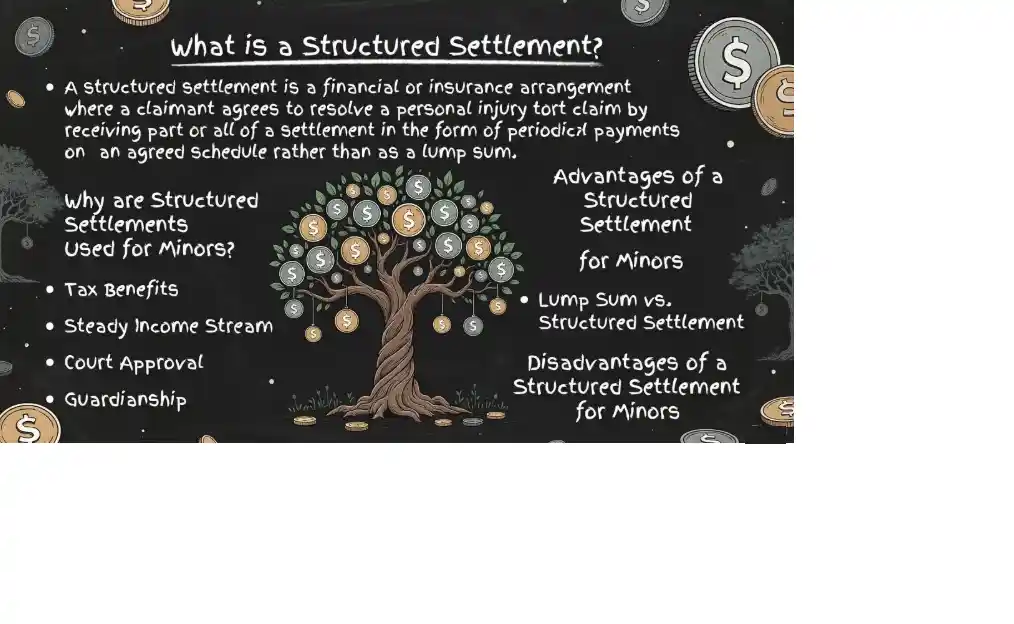
A structured settlement uses part or all of the child’s settlement to purchase an annuity from a highly rated life insurance company. The annuity then pays the child according to a schedule designed around their future needs.
For example, the structure might provide:
- Smaller annual payments during childhood for medical or care needs.
- Larger lump sums at 18, 21, and 25 for education, training, or housing.
- Lifetime monthly income for a severely injured child who can’t work as an adult.
Structured settlements are recognized under U.S. tax law and explained in more detail on Wikipedia’s structured settlement page and in educational resources from organizations such as the National Structured Settlements Trade Association.
2. Why Judges Often Prefer Structured Settlements for Minors
Many judges are cautious about approving large cash settlements for children. They know from experience that:
- Parents may be under financial stress and tempted to use funds for their own debts.
- Teenagers are rarely prepared to manage a large lump sum at 18.
- Market downturns and poor investments can quickly reduce a child’s safety net.
Structured settlements help solve all three problems:
- The money is dedicated to the child and cannot be casually withdrawn.
- Payments arrive on a fixed schedule, not as one tempting windfall.
- The annuity is not tied to daily ups and downs of the stock market.
Educational materials for judges and lawyers often emphasize that a structured settlement is one of the most reliable ways to protect a minor’s settlement and secure faster court approval.
3. Key Benefits of Structured Settlements for Minors
3.1 Tax-Free Growth and Payments
In most physical injury and physical sickness cases, payments from a structured settlement are income tax-free under Internal Revenue Code Section 104(a)(2).
That means:
- The original settlement funding the annuity is tax-free.
- The interest and growth inside the annuity are also tax-free.
- The child does not owe annual income tax on the payments.
By contrast, trust accounts generally pay tax on earnings, and money invested from a lump sum is usually taxed, which can significantly erode long-term value.
3.2 No Management Fees or Investment Risk
With a properly designed structured settlement for a minor, there are usually no separate management fees or advisor charges to the family. The cost of the annuity is baked into the pricing at the time of settlement.
Unlike trusts or investment accounts, the child’s future does not depend on:
- Stock market performance.
- The skill (or luck) of an investment manager.
- Changes in interest rates from year to year.
The payments are guaranteed according to the contract with the life insurance company, subject to the insurer’s claims-paying ability and state guaranty protections.
3.3 Fully Customizable Payment Schedule
Structured settlements are flexible at the design stage. Together with your attorney and a settlement planner, you can create a payment schedule that matches the child’s expected needs:
- Lump sums for college or trade school expenses.
- Monthly or annual income during early adulthood.
- Additional lump sums for medical equipment, surgeries, or home modifications.
- Lifetime payments for a child unable to work as an adult.
This tailoring is one of the biggest advantages of structured settlements for minors compared to the “all or nothing at 18” approach of a blocked account.
3.4 Strong Protection Against Financial Exploitation
Parents often worry that others will try to take advantage of their injured child—today or in the future. Structured settlements help protect against this in several ways:
- The funds are converted into an annuity owned by an assignment company or insurer, not the parents.
- The child cannot simply withdraw or cash out the entire amount at 18.
- Any attempt to sell payments usually requires court approval under structured settlement protection laws.
For many families, that level of protection brings real peace of mind.
4. Structured Settlement vs. Trust vs. 529 Plan
4.1 Structured Settlement vs. Trust
The PDF you provided highlights three core differences between structured settlements and trusts: security, taxes, and fees.
- Security: Structured settlement payments are regulated by state insurance departments and backed by the insurer’s claims-paying ability. Trusts are exposed to investment losses and market swings.
- Taxes: Structure payments in qualifying injury cases are typically tax-free. Trust investment earnings are often taxed at relatively high trust tax rates.
- Fees: Trusts often require annual management fees and accounting costs. Structured settlements generally have no ongoing fee to the child.
Trusts still have a place when parents need extreme flexibility or when planning around public benefits and complex estates—but for many middle-income families, the simplicity and stability of a structured settlement is more attractive.
4.2 Structured Settlement vs. 529 College Savings Plan
Some parents ask whether they should simply put settlement funds into a 529 college savings plan instead of using a structure. The PDF insightfully compares the two: both allow tax-free growth, but they behave very differently.
- Use of funds: 529 plans are generally limited to qualified education expenses. Structured settlements can fund education, medical needs, housing, training, or other life costs.
- Guarantees: Structured settlement payments are guaranteed by the annuity contract. 529 plans are investment accounts and can lose value.
- Penalties: Using 529 funds for non-education costs may trigger taxes and penalties. Structured settlement payments can be used for any of the child’s needs without those penalties.
In many cases, a structured settlement is the better “all-around” solution, while a 529 can be layered on separately if the family wants a dedicated education bucket.
5. Cost, Safety, and Court Reporting
5.1 Does It Cost a Lot to Set Up a Structured Settlement?
One of the more surprising facts for parents is that structured settlements usually cost the child nothing to set up. The cost of the annuity is part of the settlement negotiation and paid by the defendant or its insurer, not by separate fees taken from the child’s account.
By comparison, trusts can cost thousands of dollars to establish and hundreds or thousands per year to maintain.
5.2 Safety and Insurance Company Strength
Structured settlements are funded by life insurance companies that issue annuities. Their financial strength can be reviewed through rating agencies such as A.M. Best, Moody’s, or Standard & Poor’s, and on platforms like Yahoo Finance.
If a life insurer ever fails, most states provide a safety net through a life and health insurance guaranty association. Coverage limits vary, but more information is available from the National Organization of Life & Health Insurance Guaranty Associations (NOLHGA).
5.3 Court Reporting Requirements
Courts often require regular reporting for trusts or blocked accounts—annual statements, itemized expenses, and explanations of why each withdrawal benefited the child. With a structured settlement, the payment stream is fixed and predictable, so many courts do not require ongoing reporting after approval.
6. Structured Settlements for Minors Who Need Lifetime Care
If a child’s injuries are severe enough that they will likely need assistance or specialized care as an adult, the stakes are even higher. In these cases, a structured settlement can be tailored to provide income for decades or even for the child’s lifetime.
For example, the structure might include:
- Monthly income to cover ongoing home care or assisted living costs.
- Lump sums every 5–10 years for new medical equipment, vehicle replacements, or home modifications.
- Payments guaranteed for life or for a minimum number of years, so the child does not outlive the income.
No blocked account and few traditional trusts can offer that combination of tax-free guarantees, long-term planning, and protection from poor investment results.
7. Short, Human Explanation: What a Structured Settlement Means for a Child
It’s easy to get lost in charts and legal terms. At a human level, a structured settlement for a minor is about one simple idea:
“Making sure the money is still there when your child genuinely needs it.”
Instead of a single lump sum that can disappear quickly—whether from medical bills, impulsive spending, or financial pressure—a structured settlement stretches the value of that settlement across the child’s life. It can help pay for:
- Rehabilitation and therapy in the teenage years.
- Tuition, training, or tools for their first career.
- Safe transportation, housing, or assistive devices.
- Daily living needs if they cannot work full-time as an adult.
It is not a magic solution or a guarantee of a perfect life. But for many families, it is a practical, sober way to turn one painful event into long-term security.
8. Extended Q&A: Common Questions Parents Ask
Q1. Can parents access the child’s structured settlement funds?
In general, no. The money from a structured settlement belongs to the child. Courts are very protective of minor settlements and rarely allow parents to redirect or spend this money on their own needs. If payments are designed to help with the child’s care while they are still young, the family may receive those payments—but they are legally considered the child’s benefit, not the parents’ windfall.
Q2. Can parents sell a minor’s structured settlement?
Courts take an extremely cautious approach to selling a child’s future payments. Most states have Structured Settlement Protection Acts that require a judge to review any sale and approve it only if it is clearly in the best interest of the payee. Many judges simply refuse sales involving minors, except in rare emergencies. For a deeper dive into this topic, see: Can Parents Sell a Minor’s Structured Settlement? .
Q3. What happens at age 18 or 21 with a structured settlement?
Unlike a blocked account, a structured settlement does not automatically cash out when the child turns 18. Instead, the child simply becomes the legal owner of the right to receive future payments. If the schedule calls for gradual payments through their 20s or 30s, those payments continue as planned, helping protect them from the “instant millionaire” problem that often leads to poor decisions.
Q4. Are structured settlement payments for minors indexed to inflation?
Most structured settlements use fixed payment amounts that do not change over time. It is possible to design a structure with built-in cost-of-living adjustments (COLAs), but this has to be chosen at the time of settlement and usually reduces the starting payout amount. When designing a structure, your attorney and planner should help you weigh inflation risk against other priorities.
Q5. Can part of the settlement be paid in cash and part structured?
Yes. Many minor settlements are “hybrid” arrangements. For example:
- A portion of the settlement might go into a blocked account or cash to cover immediate medical, housing, or family needs.
- The remaining funds are placed in a structured settlement to support the child’s longer-term future.
Courts generally like this approach when it’s well-justified and clearly focused on the child’s benefit.
Q6. How does a structured settlement affect Medicaid or SSI eligibility?
This is a complex area and varies by state. In some cases, structured settlement payments can be combined with a Special Needs Trust to protect eligibility for needs-based programs such as Medicaid and Supplemental Security Income (SSI). Because these rules are technical, you should always consult an attorney experienced in special-needs planning before finalizing the settlement structure.
Q7. What if the insurance company that issued the annuity goes out of business?
Life insurers are heavily regulated, but failures can happen. If an insurer becomes insolvent, state insurance regulators may step in to transfer policies to a stronger carrier, and state guaranty associations may provide limited back-up coverage. While this is not a guarantee of full payment in every scenario, it does mean structured settlement recipients are not simply left with nothing. You can learn more from NOLHGA and your state guaranty association.
Q8. Can I change the structured settlement if my child’s needs change?
Once a structured settlement is finalized and the annuity is purchased, it is generally not possible to modify the payment schedule. The primary way people change their cash flow is by selling some of their payments through a factoring transaction, but this is expensive and must be approved by a court. For minors, judges are very reluctant to allow such sales unless there is a compelling, child-focused reason.
Q9. Are structured settlements only for very large cases?
Structured settlements are most common in moderate and large injury cases, but they can also be appropriate for smaller settlements when parents are particularly concerned about long-term security or financial discipline. Even relatively modest structures can help cover future tuition, training, or medical costs that might otherwise be hard to fund.
Q10. Who should parents talk to before deciding?
Before you choose between a blocked account, trust, or structured settlement for a minor, it’s wise to speak with:
- Your child’s injury attorney or trial lawyer.
- A licensed, experienced structured settlement consultant.
- A financial planner or CPA familiar with settlement and tax rules.
- A special-needs planning attorney, if your child has a significant disability.
A good team will explain your options in plain language and help you build a structure that fits your child’s life—not just a spreadsheet.
9. Conclusion: Choosing Long-Term Safety Over Short-Term Temptation
After a child’s injury, no amount of money can truly “make things right.” But a fair settlement, handled wisely, can provide meaningful support for decades. That’s what this entire discussion is about.
Among all the options, structured settlements for minors stand out for their ability to:
- Deliver tax-free income over many years.
- Protect the child from bad financial decisions at 18.
- Reduce or eliminate management fees and market risk.
- Give judges and parents confidence that the money is truly reserved for the child’s needs.
Every situation is unique. Some families will choose a blend of cash, blocked accounts, trusts, and structured settlement payments. The key is to slow down, ask questions, and design a plan that reflects your child’s medical reality, personality, and long-term dreams.
If your child’s case is approaching settlement, now is the time to ask your attorney:
“What structured settlement options are available for my child—and how can we design them to protect their future?”
Disclaimer: This article is for informational purposes only and does not constitute legal, tax, or financial advice. Always consult qualified professionals about your specific situation.




1 thought on “Structured Settlements for Minors: A Complete Guide to Protecting Your Child’s Settlement”